

Redefining Safety: Why Your Nervous System Needs Less Pressure, Not More Advice
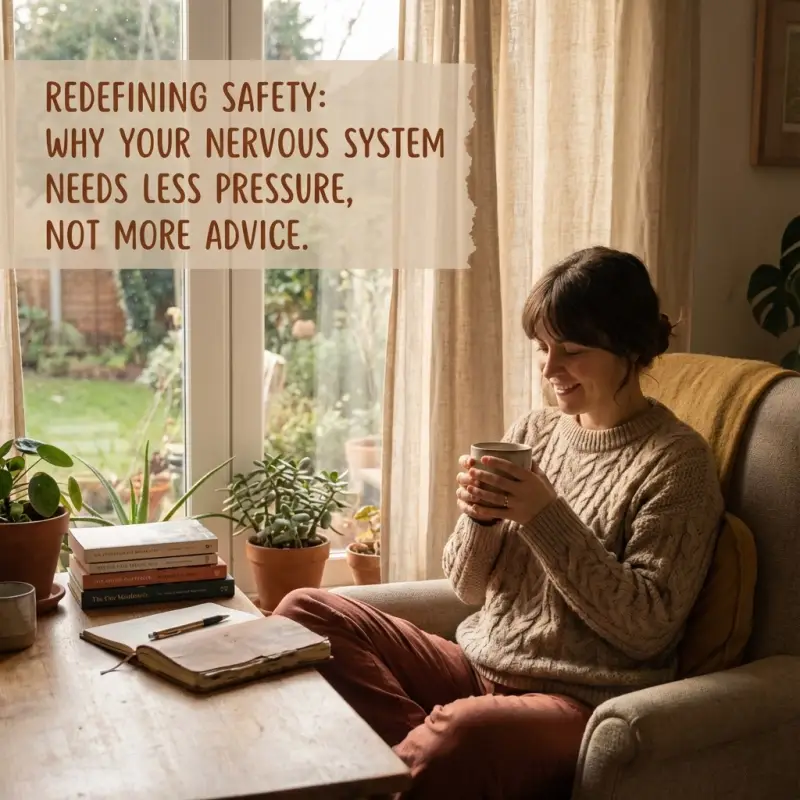
There's something profoundly exhausting about being told to feel safe when your body refuses to cooperate. You've read the books, practiced the breathing techniques, and repeated the affirmations. Your mental health toolkit is impressive. Yet something deep within you remains on guard, waiting for the other shoe to drop.
If this resonates, you're not broken: you're human. And you're about to discover why spiritual healing isn't always about adding more practices to your life, but about removing the invisible pressure that keeps your nervous system in a state of quiet vigilance.
When Understanding Isn't Enough
Safety is often talked about as a mindset, belief, or emotional state. In reality, safety is a physiological experience.
Your nervous system decides whether it can relax long before your mind assigns meaning to the moment. This is why you can understand yourself deeply: know your triggers, your patterns, your story, and still feel tense, guarded, or inexplicably tired.
Think about it: when was the last time you felt truly at ease without having to work for it? When did you last experience stillness that didn't feel temporary or conditional?
The body keeps its own counsel, responding to signals your conscious mind might miss entirely.
The Invisible Weight of Constant Bracing
Many of us live in a near-constant state of bracing without realizing it. We brace through inner dialogue, over-responsibility, self-correction, or constant reflection. These habits often began as survival strategies: brilliant adaptations that helped us navigate unpredictable or demanding environments.
But here's what's thought provoking: what once protected us can quietly become our baseline. The very mindfulness practices meant to liberate us can become another form of self-monitoring. The spiritual path intended to free us can transform into spiritual performance.
Signs You Might Be Living in Braced Mode:
- Rest doesn't quite restore you
- You feel tired in a way sleep doesn't fix
- Stillness feels foreign or temporary
- You're always "working on yourself"
- Relaxation requires effort or technique
Journal reflection: Notice, without judgment, where you might be bracing right now. Is it in your jaw? Your shoulders? Your breath? Your thoughts? Simply notice.
What Real Safety Actually Feels Like
A sense of safety doesn't come from positive thinking or reassurance. It comes from the absence of pressure. When nothing is being asked, proven, or corrected, your body finally receives the signal that it can settle.
This isn't something you can force through effort or discipline. You can't think your way into nervous system safety any more than you can think your way into falling asleep.
Safety feels different from motivation. Safety doesn't energize or activate: safety stabilizes. It allows your system to stand without leaning on constant thought, belief, or reassurance. When safety is present, the need to explain or justify yourself begins to fade

True safety whispers: "You can stop performing now."
The Language of Safety
This is why certain voices feel grounding while others feel draining, even when the words are similar. Tone, pace, and absence of demand matter more than content. A regulated human voice communicates safety through steadiness and restraint. Your body listens carefully for these signals.
When someone speaks from a place of genuine groundedness: without agenda, without need for you to be different: something in you recognizes it. Not because they're telling you what to do, but because they're demonstrating what it looks like to exist without constant effort.
Voices That Create Safety:
- Speak without urgency
- Don't push for insight or breakthrough
- Allow natural pauses and silence
- Don't need you to be "healed" or "better"
- Communicate steadiness rather than excitement
This is soul seeking in its purest form: not the relentless pursuit of the next level, but the radical act of allowing yourself to be exactly where you are.
When Healing Becomes Another Job
For people who are tired of mental noise, spiritual performance, or self-improvement cycles, this distinction often brings profound relief. It explains why so much effort hasn't led to rest. Safety was never taught. It was expected.
We've been conditioned to believe that if we just try hard enough, think clearly enough, or heal deeply enough, we'll finally feel at peace. But peace isn't a destination you arrive at through effort: it's what emerges when you stop traveling so frantically.

Sometimes the most radical thing you can do is absolutely nothing.
The vulnerability here isn't in sharing your deepest wounds or having another breakthrough. The vulnerability is in allowing yourself to exist without needing to demonstrate progress, awareness, or growth.
Beyond the Malfunction Myth
Here's something our productivity-obsessed culture won't tell you: feeling tired, confused, or "stuck" isn't a malfunction: it's often intelligence. Your nervous system might be wisely refusing to engage with more pressure, more solutions, more fixing.
What if your exhaustion isn't a problem to solve but a signal to receive? What if your resistance to another healing modality isn't stubbornness but wisdom?
Journal reflection: What if nothing about you needs to be fixed right now? How does that possibility land in your body?
The Art of Standing Down
This is not about withdrawing from growth. It's about removing pressure so growth can occur naturally. When your nervous system is no longer defending itself, clarity and self-trust have room to return.
Think of it like this: you can't force a flower to bloom by pulling on its petals. But you can create conditions: good soil, appropriate water, gentle light: where blooming becomes inevitable.
The same is true for your inner landscape. Instead of adding more techniques, more awareness, more healing work, what if you focused on removing the subtle pressures that keep your system activated?

Creating Internal Safety:
- Notice when you're pushing for insight
- Allow confusion without needing to resolve it immediately
- Give yourself permission to not be "spiritual" or conscious for moments
- Practice existing without an agenda for yourself
- Let some emotions simply pass without analyzing them
The Permission You've Been Waiting For
If this perspective feels grounding rather than stimulating, that response is meaningful. It suggests your system recognizes steadiness when it encounters it. You're not broken for wanting less pressure. You're not weak for needing gentleness. You're not behind for craving simplicity.
You have permission to:
- Stop monitoring your progress
- Exist without constant self-improvement
- Feel tired without making it mean something
- Want stillness more than excitement
- Trust your body's wisdom over external advice
This is mindfulness in its most natural form: not the effortful watching of thoughts and feelings, but the easeful being with what's already here.
The Paradox of Effortless Growth
When the nervous system is no longer defending itself, something beautiful happens. Growth begins to occur organically. Insights arise without forcing. Clarity emerges without grasping. Solutions appear without efforting.
This isn't magical thinking: it's basic nervous system biology. When you're not using all your energy to stay safe, that energy becomes available for creativity, connection, and natural development.
Final reflection: What would it feel like to trust that you're exactly where you need to be, moving at exactly the right pace, even if: especially if: that pace is slower than you think it should be?

The invitation here isn't to do anything different. It's simply to notice what happens when you stop asking so much of yourself. Your nervous system has been waiting for this permission for a very long time.
Sometimes the most profound healing happens not through action, but through the radical act of finally allowing yourself to rest in your own skin, exactly as you are, exactly where you are, with nothing needing to change in this moment.
In this space of true safety, you don't need to become anyone. You simply get to remember who you've always been underneath all the trying.